


College enrollment is sliding — exacerbated by the attrition of male students. At four-year institutions, men now make up just 42% of all traditional-aged undergraduates, down from 47% in 2011. Only 37% of young men under age 35 hold a bachelor’s degree compared to 47% of young women. According to the Pew Research Center, many young men say they don't want or need a degree for their careers; a disinterest that often begins in K-12, where boys begin lagging behind girls academically.
If higher education wants to bring men back, institutions can’t do it alone. They’ll need help from the people young men trust most — the ones who raised them.
Parents Drive College Choice for Men
Parents play a pivotal role in the college search. Students consistently describe them as their main influencers, and both students and parents generally agree that the college search is a family affair. But as Figure 1 reveals, parents of sons might be even more involved than parents of daughters.
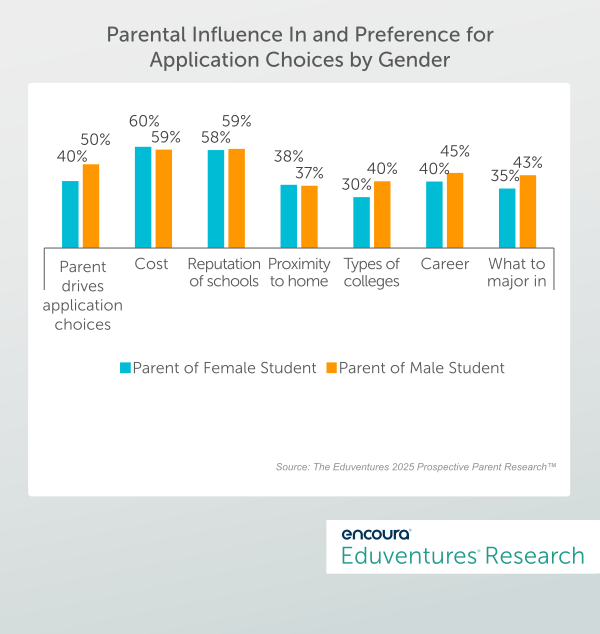
Figure 1.
Half of the parents of male students in the Eduventures 2025 Prospective Parent Research said they primarily drive their sons' application choices, compared to 40% of parents of female students. Parents of sons also have stronger preferences for college type, career, and major. Given that men, on average, are less active in the college search, parents of sons may be compensating with greater involvement.
Keep in mind, these are the parents who want their sons to pursue higher education. They are more likely than parents of daughters to view their own college experiences as valuable, report higher household incomes, and invest more in their sons’ educations — spending $26,700 annually versus $23,100 for daughters after financial aid.
What would they like their sons to study? The top choices are engineering, computer science, and business. And parents of sons are more likely to describe their top application choice as “career-minded” or “high quality” than parents of daughters, evidence that earning potential is top of mind. Whether this is a projection of these parents’ own experiences, a reflection of the students’ personal interests (or perhaps those of their parents), or a cultural bias pressuring men to become primary breadwinners, financial outcomes are key.
Men See Alternatives
This research suggests that families are more likely to encourage sons to attend college when parents’ own higher education experiences paid off economically — and they want the same for their children. But not all families share that experience. Although they fall outside this sample, Student Mindsets™ data across the pipeline reveals clear patterns in who attends college and who does not.
Figure 2 shows how Mindsets of students shift from the inquiry to the enrollment decision stage, broken down by gender.
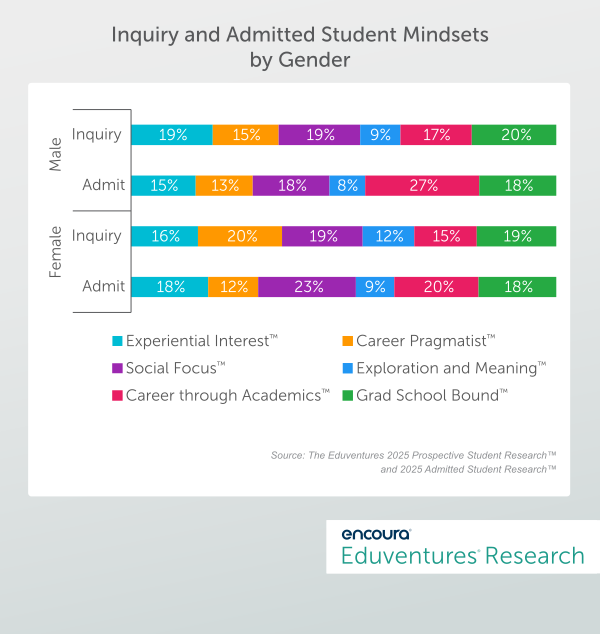
Figure 2.
At the inquiry stage, male students show a mostly balanced Mindset profile, led by Grad School Bound, Experiential Interest, and Social Focus. Early in search, men are drawn to hands-on experiences, graduate school preparation, and social connections. Women, by contrast, are more likely at this stage to prioritize clear return on investment (Career Pragmatist).
But something shifts as students progress through the funnel. Men who committed to attending college are now predominantly focused on career preparation through rigorous academics (Career Through Academics). They lose their focus on social connections (Social Focus) or hands-on learning (Experiential Interest), both of which increase among women.
What happened? College-bound men who remain in the pipeline maintain career focus but shift from experiential learning and ROI concerns toward academic preparation. For male students seeking hands-on training or concerned about cost, the cost-benefit calculation may not add up — and their parents may be encouraging alternatives to higher education.
The Eduventures 2025 Admitted Student Research found that 6% of men who progressed through search, applied, and were admitted ultimately chose not to enroll at a two-year or four-year institution. Their top alternatives were taking a gap year (25%), working (21%), and joining the military (20%). While about a third say they plan to enroll later, many report little motivation for college, citing immediate earnings, burnout from formal education, or a lack of perceived need for a degree.
These men initially considered college but ultimately don't see the value. Many more never enter the pipeline at all. Their parents likely have a hand in these choices. Bringing men back will require convincing the entire family of higher education's value.
The Bottom Line
To bring men back into the college pipeline, institutions must make a stronger economic case — recognizing that men, and their parents, approach college more transactionally. Institutions seeking to strengthen male enrollments should:
- Lead with economic proof points. Showcase alumni earnings, job placement rates, and employer partnerships prominently in all male-focused outreach. Frame financial conversations around earning premiums and ROI timelines — not just cost. Show why college delivers better long-term outcomes than immediate work.
- Target parents of sons directly. Highlight practical skills development, career outcomes, and ROI metrics rather than broad educational benefits.
- Market stackable, skills-based credentials. Clearly articulate the competencies students gain, especially in high-demand technical fields. Create structured gap-year and bridge programs with skill recognition and guaranteed re-admission to recapture men who step away but may return.
- Offer shorter, lower-cost pathways aligned to labor markets. Expand accelerated degrees and certificate-to-degree pathways. These options directly address the Experiential Interest and Career Pragmatist Mindsets common among men at inquiry but lost through the funnel. Emphasize outcomes over seat time through competency-based progression, prior learning assessment, and work-integrated options.

